Patient wearable family · Working prototypes in testing
MARLIV
Vests · Standalone sensors · Android app
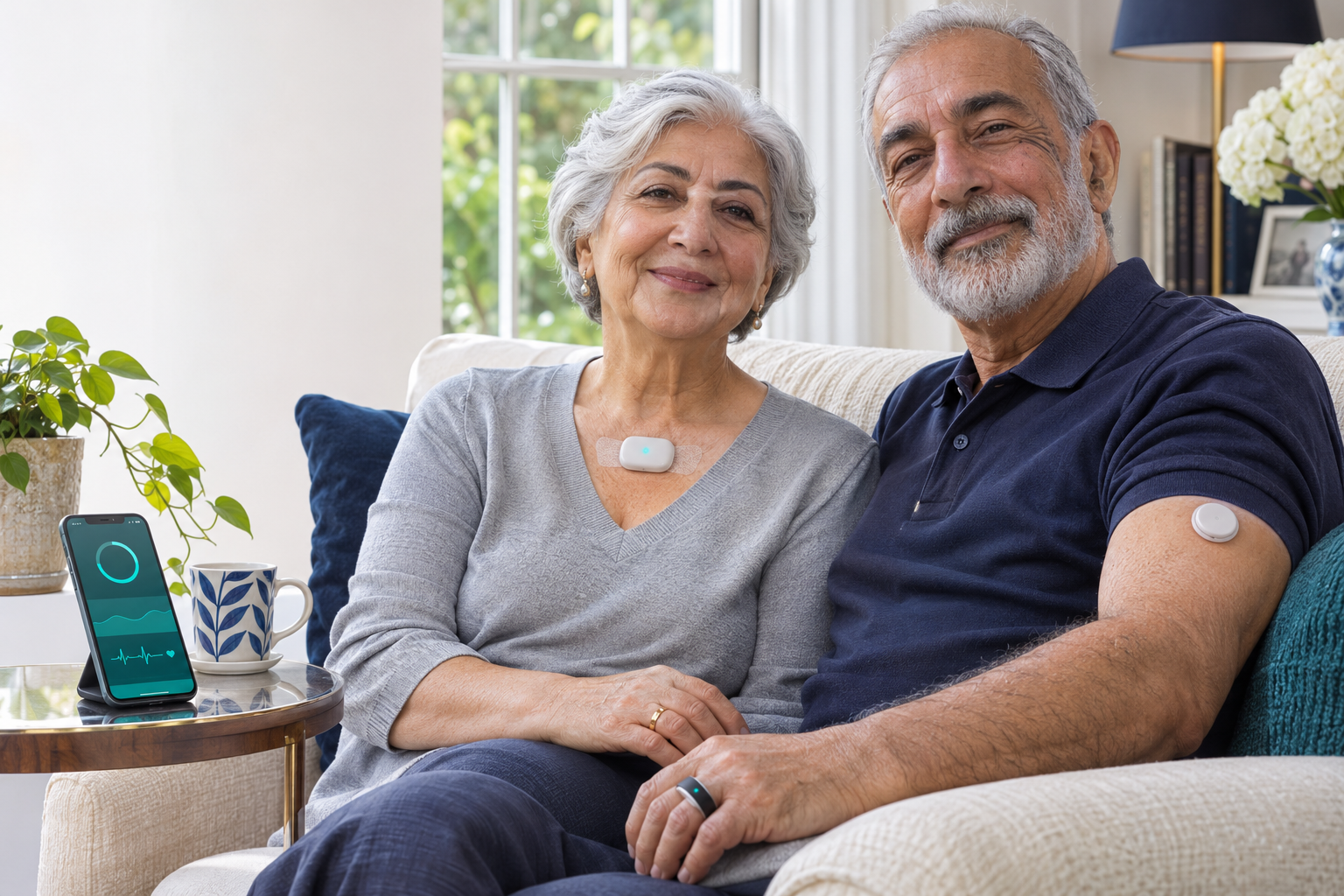
A connected patient ecosystem powered by MIMIC. Explore three vest models or select individual monitoring sensors — with or without a vest — for the MAR Body Monitor companion app.
All MAR products have working prototypes. We are progressing through testing, validation and work towards applicable standards, with the aim of bringing the products to market. Availability will depend on successful evaluation and the regulatory requirements of each market; launch dates are not yet confirmed.
You can discuss the products and their potential future suitability with your doctor now. Patients, clinicians and partners are welcome to contact us about development progress, future availability and research collaboration.
Prototypes are not an approved treatment option. No regulatory clearance or current prescription availability is claimed.
Wearable defibrillation, pneumatic CPR research and an integrated all-in-one concept. The monitoring patch is a separate sensor option, not a vest model.
01 · Defibrillation development
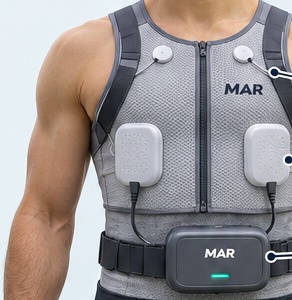
MAR Wearable Defibrillator
Dedicated ECG sensing, separate treatment electrodes and an independent local controller. Intended therapy for eligible shockable rhythms requires its own validation.
Prototype development · In testing
02 · Pneumatic CPR research
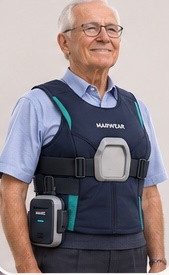
MARWEAR
A restrained pneumatic vest prototype, with a flat monitoring mode and proposed inflation-and-release compression cycle. Independent STOP / RELEASE control is part of the research design.
Working prototype · In testing
03 · Integrated vest prototype
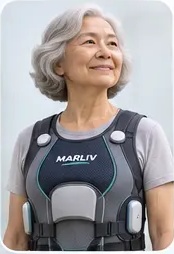
MARLIV All-in-One
Combines monitoring, proposed pneumatic CPR and defibrillation research, with MIMIC AI-supported insights and a linked patient app.
Working prototype · In testing
01 · Dedicated defibrillation development
MAR Wearable Defibrillator
A separate vest prototype with dedicated ECG sensing and treatment electrodes, intended for eligible shockable rhythms. Its independent controller and power supply keep treatment safeguards separate from the monitoring patch and companion app.
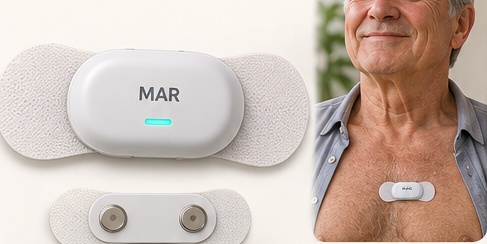
The chest patch does not deliver shocks. App connectivity is intended for monitoring and status information, not remote treatment control.
Working prototype · Testing and validation in progress
All three vests are in testing and progressing towards applicable standards. Their intended treatment functions require validation and regulatory evaluation before clinical availability.
MARLIV All-in-One · Powered by MIMIC
Sensing, smart insights and a proposed response.
The all-in-one design brings heart-rhythm monitoring, movement, skin-temperature trends and a breathing estimate into one wearable concept. Optional oxygen and authorised CGM connections add separate signals. MIMIC AI is being researched to support explainable concerns, app records and care-team alerts.
Front view
External vest design with sensing contacts and wearer controls.
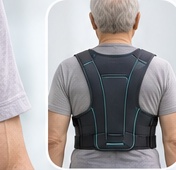
Back view
External harness and back-support design.
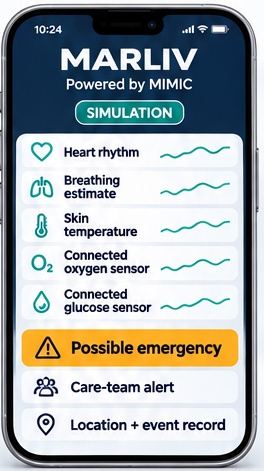
Paired app concept
Simulated readings, proposed alerts and an event record.
Proposed pneumatic CPR
The research goal is a controlled inflation-and-release cycle to support repeated chest compression and recoil. Automatic CPR requires validated arrest detection and engineering, clinical and regulatory evaluation.
Independent treatment safeguards
The concept uses a dedicated local controller and separate therapy electrodes. Defibrillation research concerns eligible shockable rhythms only; treatment must not depend on a phone or cloud AI.
Working prototype in testing — not an approved treatment option. Treatment performance, proposed alerts and emergency-service connections require validation and applicable regulatory evaluation.
MAR patient wearables
Choose modules for the patient’s needs.
Twelve monitoring concepts within the MARLIV family, designed for use with or without the vest. Planned connections to the MAR Body Monitor app bring supported readings together without requiring every sensor.
01–06 · Patient signals
Core monitoring
Selectable sensors for different monitoring needs, with each signal’s source kept distinct.
Heart electrical activity
ECG patch
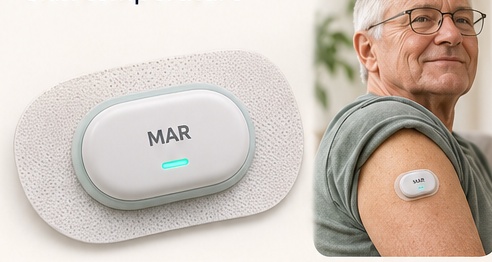
Skin-contact sensing for heart-rhythm monitoring. A single-lead patch does not replace a full diagnostic ECG.
Interstitial glucose
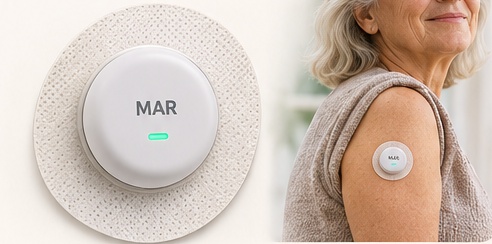
Glucose CGM
A separate CGM concept. Current app integration plans rely on authorised third-party glucose data; the chest patch does not measure glucose.
SpO₂ & pulse
Oxygen sensor
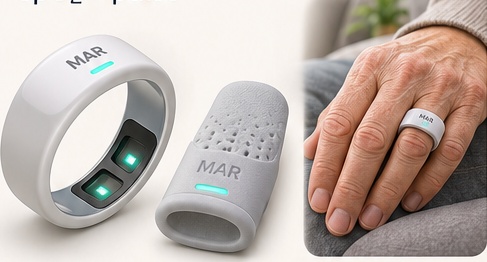
Finger-worn oxygen and pulse sensing, with sensor performance and supported connections subject to testing.
Skin temperature
Temperature patch
A dedicated skin-surface sensor concept for temperature trends, not core body temperature.
Chest movement
Breathing belt
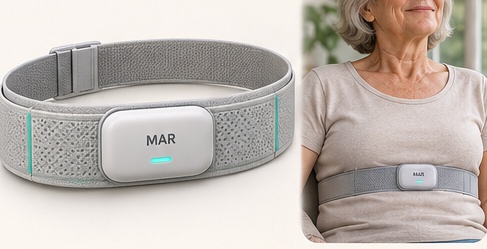
A belt concept capturing chest movement to support breathing estimates. It is a monitoring accessory, not a CPR belt.
Movement & activity
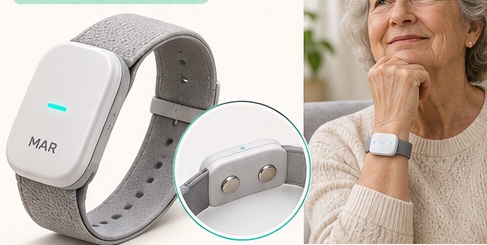
Activity wristband
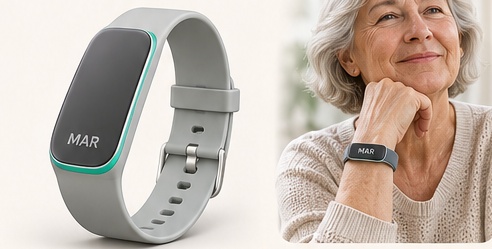
A wrist-worn concept adding movement context to the patient’s monitoring record.
07–12 · Additional perspectives
Optional & specialist modules
Additional spot-check, movement and specialist research options. Not every module is intended to be worn together.
Intermittent readings
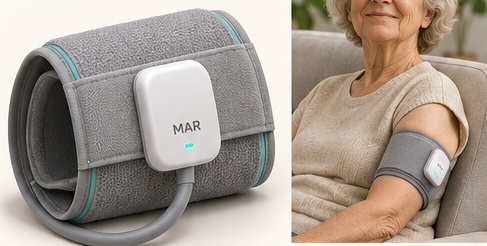
Blood-pressure cuff
An arm-cuff concept for spot checks, rather than continuous blood-pressure measurement.
Motion & orientation
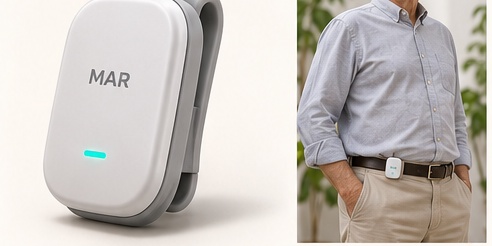
Fall / posture clip
A clip-on concept for movement and orientation data. Fall-detection capability requires separate validation.
Foot pressure & gait
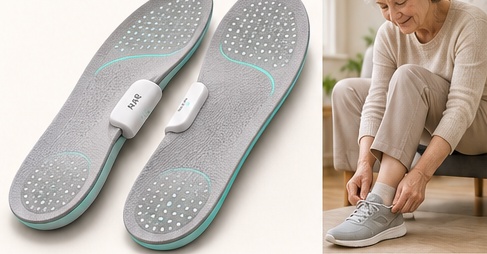
Pressure insoles
Insole concepts for studying foot loading and walking patterns.
Muscle electrical activity
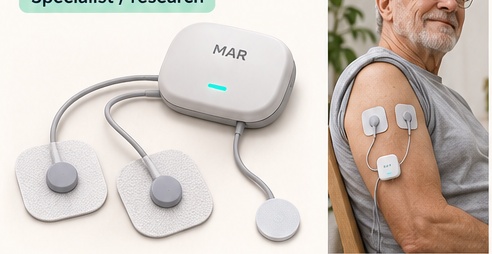
Muscle EMG patch
A specialist research concept using surface electrodes to study muscle signals.
Skin conductance
EDA wrist module
A specialist electrodermal-activity concept. Skin conductance is not a diagnosis or a direct measure of emotional state.
Brain electrical activity
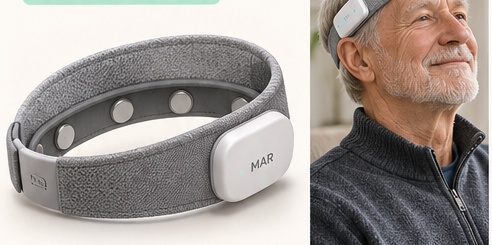
EEG headband
A specialist research headband concept for electrical signals, not a replacement for clinical EEG assessment.
All twelve modules have working prototypes in testing. Supplied graphics illustrate their designs; device-specific app integration, performance validation and work towards applicable standards continue. Future availability is not yet confirmed. Monitoring accessories do not deliver shocks or trigger treatment.
Designed around the wearer
Connected to life, not just a reading.
The aim is to make trends easier to understand: signals from the wearer, context from movement and clear device-status information. Patients remain at the centre of how their information is shared.
Signals with context
See changes over time alongside movement and signal quality.
MIMIC AI research
Time-series analysis is being evaluated to highlight explainable concerns, not diagnose illness or promise to predict cardiac arrest.
A chosen care circle
Proposed sharing with patient-approved carers and clinical contacts.
MARLIV vest · Separate treatment development
Monitoring and therapy are not the same.
The wearable vest is being developed as a separate therapy product alongside the patient sensor ecosystem. Its rhythm analysis, treatment safeguards and regulatory pathway require their own evaluation.
The phone app and cloud AI cannot trigger therapy. No validated defibrillation performance or sale readiness is claimed.
Supplied exterior design · treatment requires separate validation.
MARLIV · Patient companion app
Your signals. Your care circle.
One Android companion app for the MAR patient ecosystem. Select a supported standalone sensor without a vest, combine monitoring modules, or link a vest for status information. MAR Body Monitor brings readings, trends, MIMIC AI-supported insights and wearer-approved sharing together; device compatibility remains under evaluation.
Download coming soon
Android companion app · Prototype in testing. Release date to be confirmed.
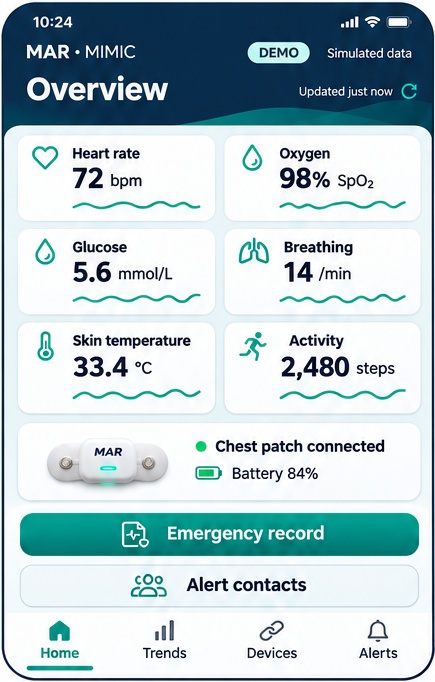
An overview of connected readings and device status.
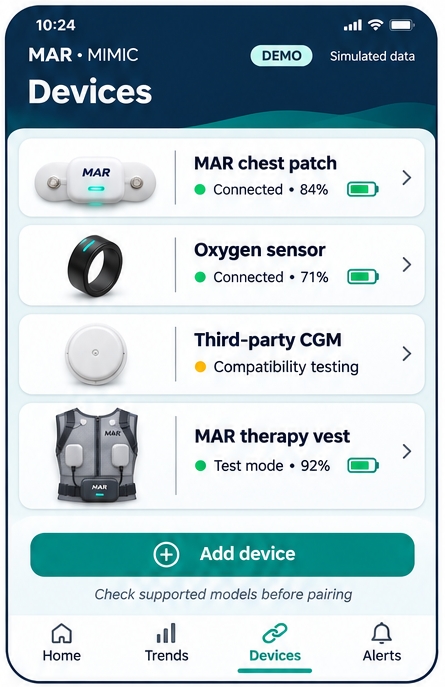
Connected devices
Patch, optional sensors and vest in one device list.
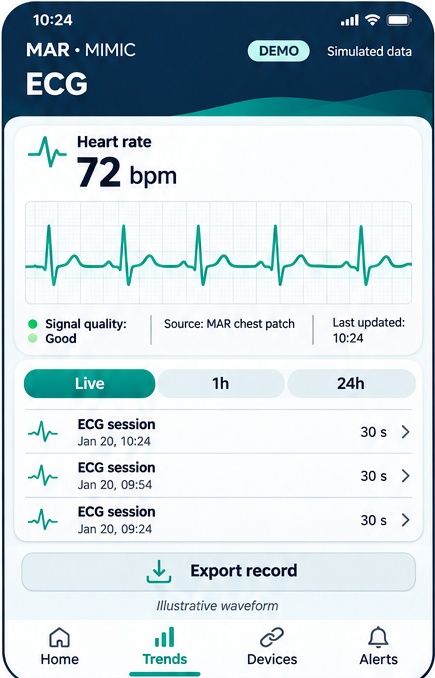
ECG trace
Single-lead signal and quality information — not a full diagnostic ECG.
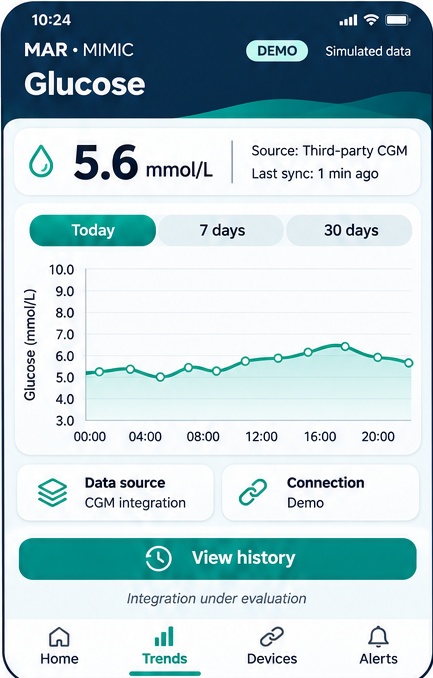
CGM connection
Glucose from a separate, authorised third-party CGM sensor.
All screens show simulated prototype data, not live patient readings. AI insights and sharing functions require validation. No staffed monitoring service or automatic ambulance dispatch is claimed.
Talk to us about MARLIV
Ask about prototype testing, research collaboration or future app availability.